

Applications
 Part of the Oxford Instruments Group
Expand
Collapse
Part of the Oxford Instruments Group

Application Notes
Published: 13 May 2024 · Last updated: 13 May 2024
The emission of greenhouse gases due to human activities is predicted to exert a profound impact on our planet's climate, oceans, and ecosystems should current production rates persist. Among these gases, carbon dioxide (CO₂) stands out as a primary contributor, being produced largely as a by-product of industrial processes. As the global community strives to achieve net-zero emissions targets by 2050, the demand for innovative technologies capable of curbing CO₂ output becomes increasingly clear.
Carbon capture and storage (CCS) is an essential technology for mitigating CO₂ emissions. This burgeoning field of research offers a compelling solution: capturing CO₂ from industrial sources, as well as directly from the atmosphere (DAC), and securely trapping it underground. The scale of the challenge is illustrated by independent energy transition assessments which indicate that 7.2 billion tonnes of CO₂ reductions by CCS and DAC are required per year by 2050 if the Paris Agreement to limit global warming to 1.5°C is to be realised.
Geological carbon storage encompasses the sequestration of CO₂ into deep geological reservoirs known as saline aquifers, or the repurposing of abandoned oil and gas fields. Injection of the CO₂ beneath impermeable strata prevents it from returning to the surface. Once confined within the reservoir, the CO₂ will undergo dissolution into saline pore water, giving rise to carbonic acid. This acid subsequently reacts with certain minerals in the reservoir rock, generating new and stable carbon-bearing minerals. As a result, carbon is permanently locked away deep beneath the Earth's surface in stable mineral phases, precluding CO₂ from returning to the atmosphere and thwarting its greenhouse warming effect.
Geoscientists from CASP, a not-for-profit independent geological research organisation, and the University of Manchester are enhancing geomechanical and geochemical models that evaluate the CCS potential of cretaceous sandstones beneath the North Sea, United Kingdom. This initiative involves plans to inject CO₂ approximately 2.5 km below the seabed, commencing in 2030.
Typically, modelling forecasts the capacity for CO₂ to permeate through and interact with the reservoir rock, and to validate that the overlying lithologies serve as an impermeable barrier, capable of confining and containing the injected CO₂. However, accurately estimating the flow dynamics and chemical interactions of a supercritical gas phase with the reservoir sandstone and its pore fluid poses considerable challenges. To reliably predict the extent of mineral reactions and the rate at which they occur, four pivotal characteristics of the rock must be precisely quantified:
Using this data, models predicting the flow of CO₂ can be updated and more accurate estimations of CO₂ injection and storage can be made for the Acorn injection site.
For many years, automated SEM analysis employing separate BSE and EDS detectors has served as the standard method for characterising the mineralogy, mineral composition, and mineral textures of reservoir rocks. Typically, software was programmed to capture BSE images and separate X-ray maps at regular intervals across the sample surface. Subsequently, these two datasets were overlaid during post-processing, and individual fields were assembled to construct a high-resolution large-area BSE image accompanied by X-ray maps. This approach necessitates thorough sample preparation, including cutting, mounting, and polishing, to ensure a smooth surface, primarily to avoid X-ray shadowing effects. Consequently, sample preparation can be exceptionally time-consuming when dealing with water sensitive and clay-rich samples.
Here, we perform fully automated backscattered electron and compositional X-ray (BEX) analysis of the target sandstone using Unity and Ultim Max 170 operated with AZtec® Live 6.1 SP1. Given that chemical and textural analysis of the sandstone is required, the combination of BSE and X-ray imaging using the BEX technique provides the most intuitive, detailed, and time-efficient manner of quantifying the sample.
A significant amount of time is saved by avoiding sequential acquisition of X-ray then BSE, and greater accuracy is achieved as data from the sample pixel at the same time is acquired.
Furthermore, the unique design of the Unity detector, and its insertion beneath the pole piece (Figure 1), allows for enhanced imaging of rough samples, permitting high quality compositional data acquisition on dry-cut and unpolished cretaceous sandstone samples. For analysis of microstructures, a polished thin section was also prepared.
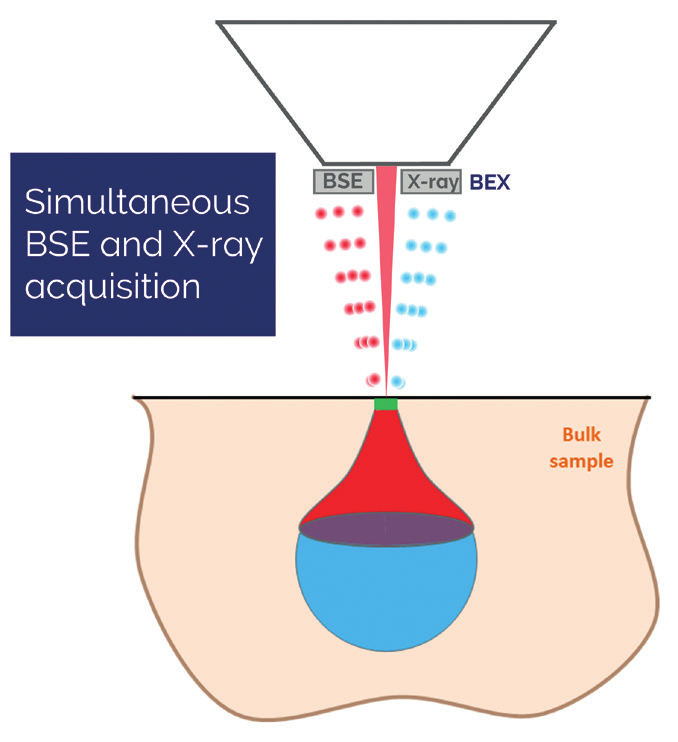
Figure 1. Schematic diagram showing the simultaneous capture of BSE and X-ray data by the Unity BEX detector, inserted beneath the pole piece.
The large area BEX maps were post processed using AutoPhaseMap, an algorithm that colour codes pixels with consistent X-ray peaks and intensities, effectively grouping similar composition minerals. Importantly, resin analysed within the pore spaces of the sample can also be classified to determine the abundance and interconnectivity of pore spaces within the sample. As BEX analysis by Unity is accompanied by Ultim Max EDS, the data can also be quantified, and average mineral compositions resolved.
A large area map of 3.75 cm² was collected using a 20 kV accelerating voltage and 7 nA beam current in two hours. This multilayer hyperspectral BEX dataset (Figure 2) includes a 300 M pixel BSE image (1.1 µm pixel size) with accompanying X-ray maps totalling 19 M pixels (4.4 µm). The AutoPhaseMap data (Table 1) confirms a significant abundance of quartz (53%) with lesser feldspar (8.3%), illite (3%) and mud 'rip-up' clasts (3.6%) within the sample; however, it also indicates that about half of the feldspar is Ca and Na bearing albite, with on average 6.3 wt.% Na and 1.8 wt.% Ca. Areas between the grains of quartz and feldspar are largely dominated by clay minerals, although a significant amount of pore space (24%), infilled by epoxy (Figure 3), is also present. More detailed investigation of the BSE image reveals that some feldspars, mainly albite, have a skeletal structure with relatively high surface areas (Figure 2C).
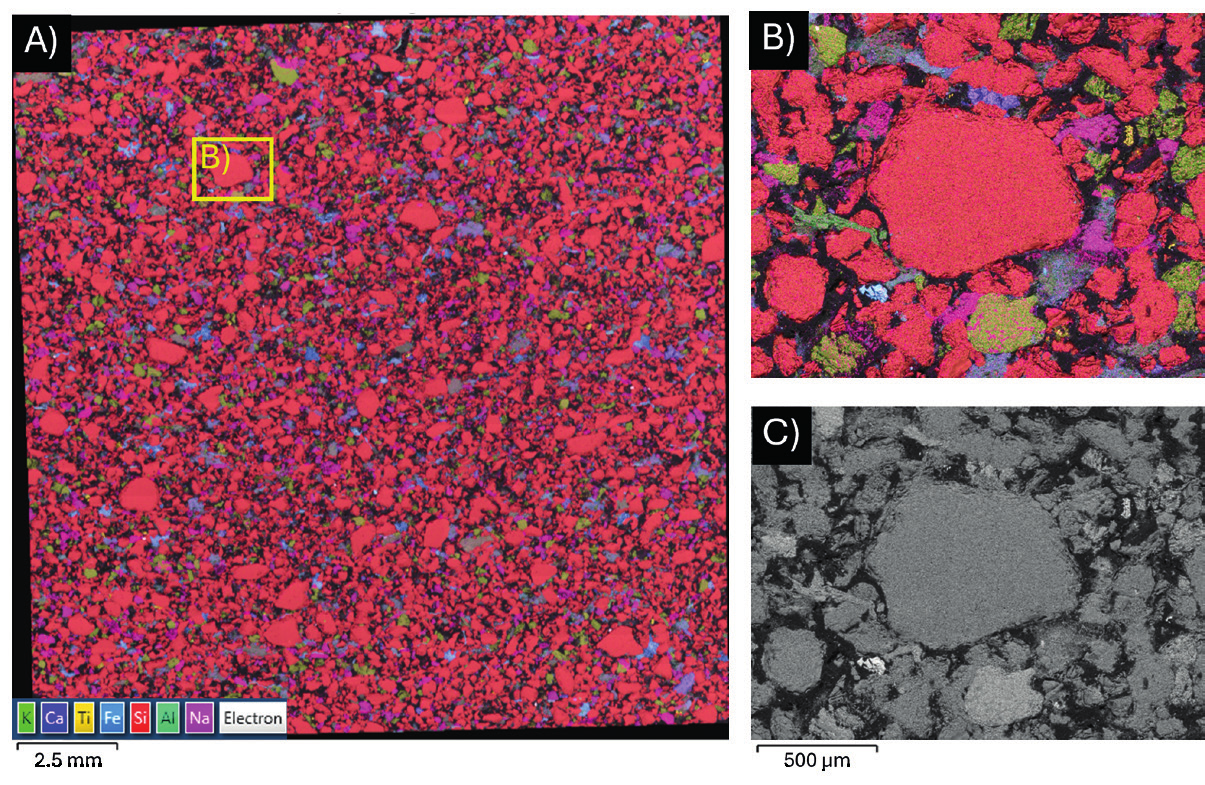
Figure 2. (A) large area BEX cartography image of unpolished Caspian sandstone displaying its macrostructure. (B) Photomicrograph extracted from large area high resolution BEX cartography displaying grain relationships and microstrucures. (C) Unity BSE image extracted from large area cartography.
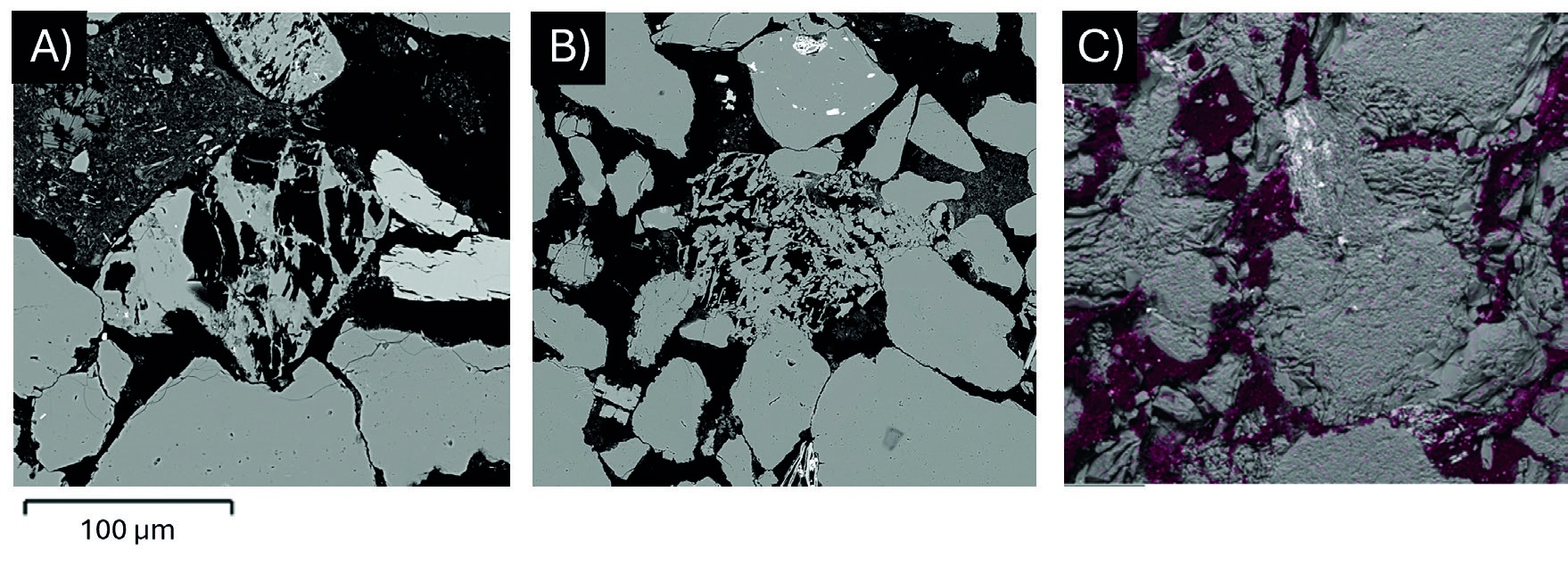
Figure 3. (A & B) Unity BSE images of skeletal albite crystals with high surface area in polished Caspian sandstone. (C) BEX photomicrograph displaying epoxy filled pore spaces of the Caspian sandstone (purple).
Table 1 – Mineral Abundance within the Caspian Sandstone
| Phase | Area (%) |
| Quartz | 52.5 |
| Epoxy | 23.6 |
| Unassigned | 12.4 |
| Albite | 4.4 |
| Orthoclase | 3.9 |
| Mud Clasts | 3.6 |
| Illite | 3.0 |
| Fe-Oxide | 0.5 |
| Calcite | 0.2 |
| Holder | 0.2 |
| Rutile | 0.1 |
Mineral classification was performed using AutoPhaseMap.
In summary, the analysis suggests that the reservoir rock contains a greater abundance of calcium and sodium-bearing feldspar than initially believed. Additionally, the discovery of the skeletal structure of sodium-rich plagioclase crystals indicates a substantially larger surface area compared to that previously assumed. These findings are particularly noteworthy as they could significantly accelerate CO₂ reactions within the reservoir during the Acorn Project injection phase. While this may mean a greater proportion of the injected CO₂ may be permanently stored as new mineral phases, it may also necessitate adjustments to the numerical modelling of CO₂ flow within the reservoir.
The BEX technique, facilitated by the Unity detector, has effectively delineated crucial aspects of the Acorn Project's target sandstone reservoir. With simultaneous X-ray and BSE detection, and beneath the pole piece geometry, this technology has enabled breakthrough speeds for classifying mineral abundances, compositions, and textures. Thus, facilitating a nuanced comprehension of reservoir rock characteristics, carrying important implications for CO₂ injection and storage strategies. Armed with this newfound data, researchers on the Acorn Project have been empowered to develop carbon offsetting technologies striving towards achieving net-zero emissions targets.
Oxford Instruments extends great thanks to Dr. Maichel Flowerdew of the Cambridge Arctic Shelf Programme for providing samples and support with the writing of this document.

© Oxford Instruments 2026